
Invest in these funds through the SIP route with at least a seven-year horizon.

Indian drugmakers supply 47 per cent of the generic medicine requirements in the US, and tariffs would have increased prices in the US domestic market for patients, who are already dealing with drug shortages.

Strong macroeconomic headwinds causing turbulence in the $245-billion Indian IT industry are yet to calm down. Top Indian IT services companies are likely to post a decline or just marginal growth in sequential revenue in Q1FY24 because of a soft discretionary spending environment. Though the first quarter is seasonally strong for IT firms, "June 2023 will be an exception", according to analysts at Kotak Institutional Equities.

For every rupee in the government coffer, 58 paise will come from direct and indirect taxes, 34 paise from borrowings and other liabilities, six paise from non-tax revenue like disinvestment and two paise from non-debt capital receipts, according to the Budget documents for 2023-24.

Chinese import tariffs have unwittingly come to India's assistance to help boost imports of US liquefied petroleum gas (LPG) at rates cheaper than what it pays for supplies from West Asia, according to industry sources and shipping data.
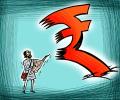
The Centre is staring at a combined shortfall of up to Rs 1 trillion in excise and Customs revenues in the current financial year (FY23) compared to the Budget estimates (BE), mainly because of duty cuts on edible oil and petroleum products. The government set a target of Rs 3.35 trillion for excise and Rs 2.13 trillion for Customs mop-up for FY23 while presenting the Budget in February. "As excise duty collection is mainly driven by diesel volumes, we might see a clear gap in the level budgeted for FY23, following the reduction in cesses on petrol and diesel in May. We are expecting somewhere between Rs 80,000 crore and Rs 1 trillion dip in excise and customs duty collections," a senior government official told Business Standard.

Tax devolution shares, which threaten to create a north-south divide among states, may have more to do with per capita income, and not so much with population.

'I believe the modified scheme is much more beneficial and simpler.'

Biggest culprit behind India's eroding tax base is excise

The country's largest airline IndiGo on Friday saw its profit after tax slide 18.3 per cent to Rs 2,448.8 crore in the three months ended December 2024 due to foreign exchange loss even as revenue jumped on higher capacity and passenger traffic. The carrier, which had a fleet of 437 planes at the end of December, is planning to induct wet leased planes for long range flights and expects the number of grounded aircraft to come down to 40s by the start of next financial year from the current level of 60s.

The time is ideal for a 'Dream Budget' akin to the 1991 reforms that sparked high growth and unlocked significant gains in productivity, points out Rajeswari Sengupta.

From the Sensex basket, Power Grid, Asian Paints, Tata Motors, Tata Steel, NTPC, Sun Pharma, Mahindra & Mahindra, HDFC Bank, Tata Consultancy Services and JSW Steel were among the major gainers. Kotak Mahindra Bank, Bharti Airtel, Axis Bank, Wipro, ICICI Bank and IndusInd Bank were among the laggards.

'Spend, but create assets, spend but make sure that people benefit from it.' 'This has been a beautiful guiding principle. And I think as a finance minister I owe so much to the prime minister for keeping this path clear before us.'

The government had budgeted revenue realisation for 2012-13 fiscal at Rs 10.38 lakh crore (Rs 10.38 trillion).
The GST Council on Saturday clarified that guarantees provided by corporate to their subsidiaries will attract an 18 per cent GST, while no tax will be levied if a personal guarantee is given by a director to the company. The council, chaired by Union Finance Minister Nirmala Sitharaman and comprising state ministers, also cut the GST rate on molasses to 5 per cent from 28 per cent. It also ceded the right to tax Extra Neutral Alcohol (raw product for making alcohol for human consumption) to the states.
Of the two rate structures on the table, one suggests tax slabs of 8 per cent, 16 per cent, and 24 per cent. The other proposes tax slabs at 9 per cent, 18 per cent, and 27 per cent.

Dream11, Baazi Games, Zupee and WinZO among others are invited for the discussion with the anti-money laundering watchdog.

The government has budgeted for total expenditure of Rs 34.83 lakh crore or 6.8 per cent of GDP. While the net tax revenue rose from Rs 5,75,697 crore in October 2020 to Rs 10,53,135 crore till October 2021, a growth of 82.93 per cent annualized, total expenditure rose only by 9.95 per cent, led by infra spending to Rs 18,26,725 crore from Rs 16,61,454 crore during the same period, the RBI said in the financial stability report.
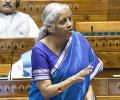
'When people have money in their hands, they make their judgment about whether they want to spend it entirely or spend some out of it.'

Reminiscent of the past two years, the market has made positive strides ahead of the Union Budget 2023-24 (FY24). The benchmark National Stock Exchange Nifty has gained 1.8 per cent in the last month. Typically, markets tend to gain ahead of the Budget as investors build in optimism.

The government has notified October 1 as the starting date for direct tax dispute resolution scheme Vivad Se Vishwas 2.0. Vivad Se Vishwas scheme 2.0 was originally announced in Budget 2024-25 presented in July for resolution of certain income tax disputes pending appeal.

The Budget has given signals that India is sensitive to the US needs and willing to walk the extra mile, but if need be, we should respond in equal measure as a sovereign nation, notes Ajay Srivastava.

Prime Minister Narendra Modi led-NDA government in its third term must tackle the problem of unemployment in the country, especially in the unorganised sector and in small and medium enterprises, former NITI Aayog Vice Chairman Rajiv Kumar said on Monday. Kumar also emphasised that the government now must finalise the four labour codes as it has been delayed beyond expectations. "We must recognise that post-COVID economic recovery has been a K-shaped recovery.

Post-election capital expenditure (capex) has been weak at 2 per cent year-on-year (Y-o-Y) in M9FY25. The FY25 revised estimates (RE) indicate 7 per cent growth in FY25 against FY24, implying 21 per cent Y-o-Y growth in Q4FY25 government capex.

Because of the economic slowdown, the actual corporation tax collection in 2012-13 was at Rs 3,56,326 crore (Rs 3,563.26 billion), up 10.4 per cent year-on-year as against 15.6 per cent estimated in the Budget.

Apple will source the majority of the iPhone sold in the US from India in the June quarter while China will produce the vast majority of the devices for other markets amid uncertainty over tax tariffs, a top official said on Friday.

Automobile giant Tata Motors' shares were in demand on Wednesday as the stock rallied as much as 3.69 per cent to hit an intraday high of Rs 671.80 per share, before settling 3.18 per cent higher at Rs 668.45. By comparison, the BSE Sensex settled 0.10 per cent, or 72.56 points, lower at 74,029.76.

Senior tax officials were told to focus on cash collection from the arrears so that the target for FY23 was achieved and the overall revenue position improved.

Recommendations on direct taxes vary from seeking cut in corporate tax, re introduction of standard deduction for salaried employees, removal of STT, DDT, etc.
Can this growth in GST collection be sustained in the coming years? asks A K Bhattacharya.
Disputes or otherwise, the government is yet to receive over Rs 1 trillion in taxes from corporates and other entities and add to it other arrears worth about Rs 47,000 crore (Rs 470 billion), the total outstanding equals more than half of the total revenue deficit this year.

The scheme offers waiver of interest, penalty, and prosecution for settling tax disputes.

After a massive selloff in the shares of food delivery giants Zomato and Swiggy, analysts believe the time may be right for investors to start adding these stocks to their portfolio carts. Their optimism, they say, stems from the sharp correction in stock prices and valuations, which seem to have "over-baked" concerns about the two companies.
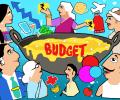
Following the lacklustre growth numbers in the second quarter (Q2FY25), economists believe the upcoming Union Budget for 2025-26 should focus on reforms that will stimulate consumption, manufacturing and spur employment. India's growth unexpectedly slowed to 5.4 per cent in the second quarter, due to low capital formation, weak consumption, besides adverse weather impact.

Mumbai, which contributes about 30 per cent of country's direct collections, saw the rate of contraction in advance tax collection lower to 20 per cent as against an over 33 per cent decline in Q1.

Revenue from divestment has fetched Rs 40,000-50,000 crore against target of Rs 2.10 trillion.

Uttar Pradesh Chief Minister Yogi Adityanath defended the Maha Kumbh, claiming it generated Rs 3 lakh crore in business and provided significant economic benefits to the region. He also highlighted the "flawless" law-and-order management during the event, citing no crime reports despite the participation of 66 crore devotees and tourists. Adityanath countered opposition criticism of the event, stating that a family with 130 boats made a profit of Rs 30 crore during the 45-day congregation.

If growth reverts to the pre-Covid level, a lot of people may have to temper their rosy optimism, points out Debashis Basu.
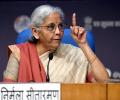
The Budget 2025-26 meets the expectations of fiscal consolidation, maintaining capital expenditure, and boosting consumption through tax cuts.

Apollo Hospitals Enterprise is set to expand presence in metro cities during FY26 with the addition of five hospitals that would add over 1,400 beds.
